

Giveaway Budget Optimization for Trade Shows: How to Maximize Impact Without Overspending

Giveaway Budget Optimization for Trade Shows: How to Maximize Impact Without Overspending
Explore Giveaway GiftsKey Takeaways
-
Giveaway budget optimization is about ROI, not cost-cutting
Smart exhibitors focus on cost per qualified conversation and conversion—not cheapest per-unit giveaways. -
Perceived value beats quantity at trade shows
Fewer, well-chosen giveaways outperform mass distribution of generic swag in lead quality and recall. -
Tiered giveaway strategies reduce waste and increase impact
Separating giveaways for visitors, prospects, and VIPs ensures the right spend reaches the right audience. -
Consumable, branded giveaways deliver higher engagement
Items like customized chocolates create immediate recall without adding clutter or baggage for attendees. -
Hidden costs can quietly inflate giveaway budgets
Shipping, storage, compliance, and rush fees must be factored into trade show budget planning to avoid overruns.
Trade shows remain one of the most expensive yet powerful channels in B2B and B2C event marketing. Booth rentals, travel, staffing, logistics, and promotion already stretch budgets thin—making giveaway spend one of the most scrutinized line items in trade show budget planning. Yet, when optimized correctly, giveaways are often the highest-return investment on the show floor.
Many brands still approach giveaways as an afterthought—ordering bulk items late, choosing the cheapest options, or over-ordering “just in case.” The result? Boxes of unused swag, poor-quality items that dilute brand perception, or giveaways that attract the wrong audience entirely. Smart marketers understand that giveaway cost optimization isn’t about spending less—it’s about spending smarter.
In the USA, where competition for attendee attention is intense, well-planned giveaway strategies can increase booth dwell time, spark meaningful conversations, and drive post-event follow-ups. Premium yet practical items—such as thoughtfully branded consumables—often outperform generic swag because they create emotional recall, not clutter.
If you’re evaluating your trade show giveaway budget USA benchmarks or trying to reduce waste while improving ROI, this guide breaks down how to plan, allocate, and optimize your giveaway spend strategically—without compromising brand impact. For brands exploring premium, customizable gifting options, solutions like curated chocolate giveaways designed specifically for expos and exhibitions can balance memorability with cost efficiency when deployed correctly.
Explore tailored options here: custom giveaway gifts for expos and trade shows .
Stand out from competitors by choosing unique giveaway gifts that go beyond standard pens and notebooks. Read more →
How Giveaway Spending Fits Into Event Marketing Spend
Trade shows account for a significant share of overall event marketing spend in the United States. According to data from industry associations like CEIR and insights summarized by Forbes, exhibitors often allocate 20–30% of their total trade show budget toward attendee engagement activities—of which giveaways are a key component.
Yet giveaway budgets are rarely planned with the same rigor as booth design or lead capture technology. Many companies set an arbitrary per-unit cost without considering audience segmentation, lead quality objectives, post-event follow-up value, or brand positioning on the show floor.
This creates a mismatch between cost and outcome. A low-cost giveaway distributed to everyone may generate foot traffic, but little brand recall. Meanwhile, a slightly higher-value item—given selectively—can drive deeper conversations and higher conversion rates.
In recent years, event professionals have begun shifting away from quantity-first thinking toward strategic distribution models. This includes tiered gifting, limited-edition items, and consumable gifts that don’t contribute to attendee clutter. Research shared by Harvard Business Review on behavioral reciprocity shows that thoughtful gifts increase perceived value and engagement far more than generic ones.
Corporate Giveaway Gifts for Expo, Exhibition & Trade Shows
Attract attention and drive brand recall with premium corporate giveaway gifts featuring personalized chocolate branding for expos and trade shows.
Explore Giveaway Gifts NowThe Core Problem: Why Most Trade Show Giveaway Budgets Underperform
Despite good intentions, many trade show giveaway strategies fail to deliver measurable ROI. The issue isn’t the concept of giveaways—it’s how budgets are allocated and executed.
Common Budget Pitfalls in Trade Shows
- Over-ordering due to poor forecasting
- Chasing the lowest per-unit cost
- One-size-fits-all giveaways
- Ignoring hidden costs
- Lack of post-event tracking
According to analysis highlighted in MIT Sloan Management Review, marketing investments without attribution frameworks are significantly less likely to be optimized over time. Giveaways are no exception.
The opportunity lies in reframing giveaways not as expenses, but as conversion tools—designed intentionally to support booth conversations, sales qualification, and follow-ups.
For a deeper look at how giveaways influence trade show outcomes, read: how giveaway gifts impact trade show ROI .
Key Concepts & Frameworks for Giveaway Cost Optimization
1. Budget Backward From Business Goals
Instead of asking how much to spend per giveaway, start with how many qualified leads you need, your acceptable cost per lead, and what post-event action you want attendees to take.
If your target CPL is $40 and giveaways historically account for 25% of engagement costs, your effective giveaway spend per qualified interaction should be closer to $10—not $2 handed out indiscriminately.
2. Segment Your Giveaway Strategy
High-performing exhibitors in the USA often use tiered giveaway models:
- General visitors: low-cost, high-visibility items
- Qualified prospects: premium, branded gifts
- VIPs and partners: limited-edition keepsakes
This approach reduces waste while increasing perceived value. Premium consumables like customized chocolates work particularly well at the engagement tier.
3. Choose Consumables Over Clutter
Data from sustainability and consumer behavior studies summarized by McKinsey Quarterly suggests attendees increasingly prefer edible or use-once gifts over long-lasting swag.
Custom-printed chocolates, for example, are often consumed within hours—creating immediate brand recall during or right after the event.
4. Optimize Quantity With Realistic Forecasting
Rather than ordering for total footfall, forecast based on average meaningful conversations per hour, booth staffing capacity, and event duration.
Many exhibitors overestimate engagement by two to three times. Tight forecasting alone can reduce giveaway costs by 20–30% without sacrificing impact.
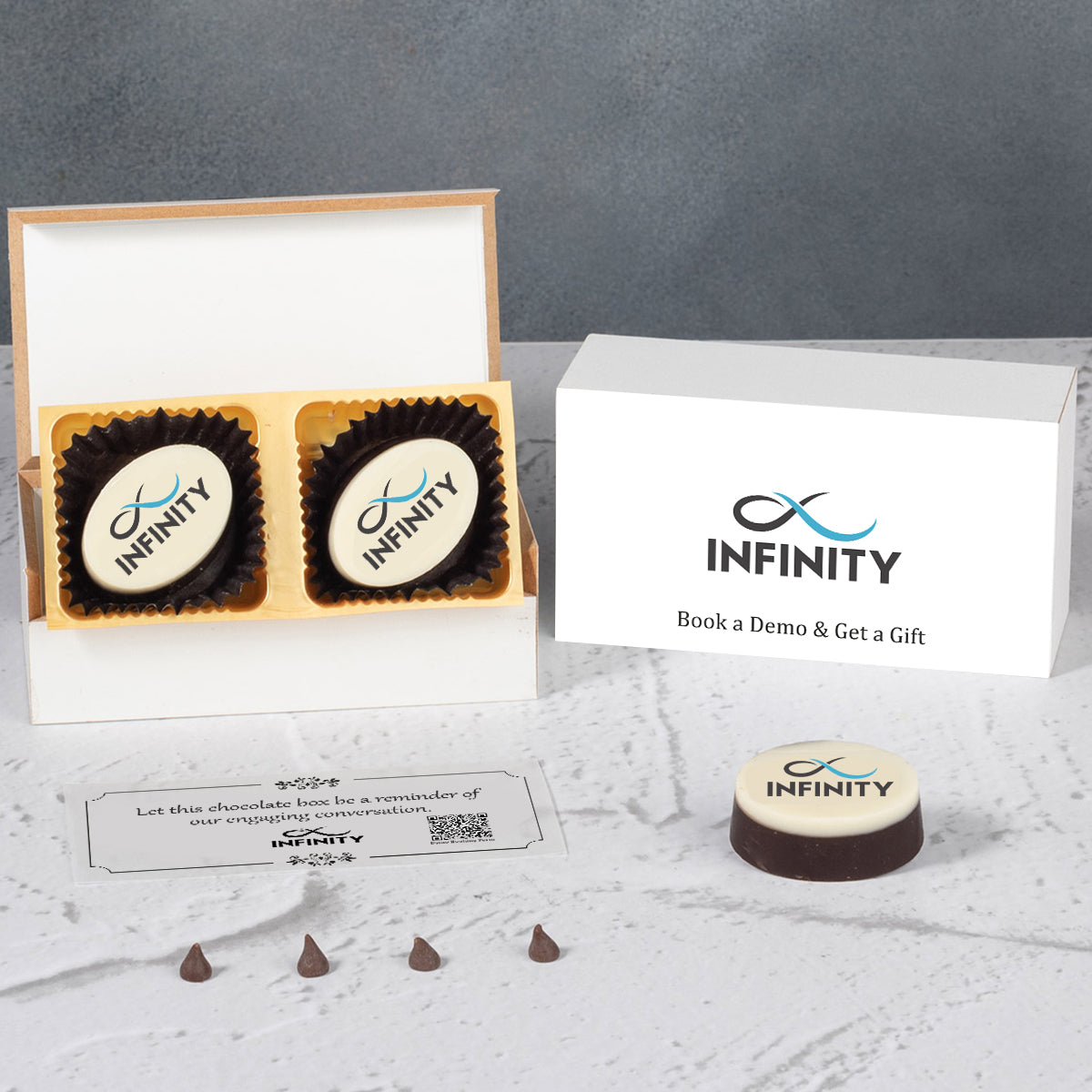
Book a Demo - Chocolate Box
📦 Box: Logo + “Book a Demo & Get a Gift”
📝 Message Inside: QR code linking to a demo booking form
🍫 Chocolates: One with “Demo” or calendar icon, one with logo
🎯 Purpose: Incentivizes visitors to book a demo, turning booth interest into qualified, scheduled leads.
Make it for your Brand
Data, Research & Real-World Examples: What Optimized Giveaway Budgets Actually Achieve
When trade show giveaways are planned with intention, the results are measurable—and often surprising. Multiple industry studies reinforce one key insight: perceived value matters more than unit cost.
Research summarized by Harvard Business Review shows that people reciprocate more strongly to gifts they perceive as thoughtful or personalized, even when the actual cost difference is marginal. In trade show terms, this means a six to eight dollar branded, well-presented giveaway can outperform a two dollar generic item in lead quality, follow-up response, and brand recall.
Similarly, CEIR (Center for Exhibition Industry Research) data indicates that attendees who engage in meaningful booth conversations are significantly more likely to remember the brand weeks later—especially when the interaction is anchored by a physical takeaway. The giveaway acts as a memory trigger, not just a freebie.
Example Scenario: Quantity vs Quality in Practice
Consider two exhibitors at the same US industry expo.
Brand A distributes five thousand low-cost items indiscriminately. Brand B distributes eighteen hundred premium, branded consumables selectively after short conversations.
Post-event analysis shows that Brand A generates more scans but lower follow-up engagement. Brand B generates fewer leads, but with higher meeting bookings and conversions.
Brand B’s event marketing spend is actually lower when measured as cost per meaningful outcome, not cost per item. This reinforces why giveaway cost optimization must focus on downstream value, not surface-level metrics.
Custom-branded giveaway gifts improve recall—your logo should feel integrated, not forced, into the product design. Read more →
Practical How-To: Step-by-Step Trade Show Giveaway Budget Planning
Step 1: Define Your Giveaway’s Job
Before setting a budget, answer one question clearly: what role should the giveaway play in our booth strategy?
Common objectives include starting conversations, qualifying prospects, reinforcing premium brand positioning, and encouraging post-event follow-up.
A giveaway meant to open dialogue should feel personal and intentional. This is where customizable items such as logo-printed chocolates or message-based gifts naturally outperform generic swag.
For guidance on aligning giveaways with your audience, read: how to choose the right giveaway for your trade show audience .
Step 2: Build a Tiered Budget Instead of a Flat One
Instead of a single giveaway budget, split it into tiers. A visibility layer for general footfall, an engagement layer for qualified prospects, and a relationship layer for VIPs, partners, or key accounts.
This approach prevents overspending while ensuring the right people receive the highest-value items.
Premium consumables work especially well in the engagement layer because they signal thoughtfulness, are easy to distribute selectively, and do not require long-term storage by attendees.
Explore scalable gifting formats here: corporate gifting solutions for events and trade shows .
Step 3: Optimize Quantity With Booth Reality
One of the most overlooked aspects of trade show budget planning is operational capacity. Ask how many meaningful conversations your team can realistically handle per day, how long each interaction lasts, and how many staff are actively engaging.
If your booth can support two hundred fifty quality conversations per day over a three-day event, ordering two thousand premium giveaways makes little sense.
For brands new to this approach, this guide explains when restraint works better: when not to give giveaways at trade shows .
Step 4: Account for Hidden Costs
Effective giveaway cost optimization accounts for more than product price. Hidden costs include rush production fees, freight and drayage, storage and handling at venues, damage or spoilage, and compliance restrictions at US convention centers.
Ignoring these factors can inflate actual spend by fifteen to twenty-five percent.
This compliance overview helps avoid surprises: trade show giveaway compliance and venue rules in the USA .
Trends and Expert Insights Shaping Giveaway Strategies
Fewer Giveaways, Better Experiences
Industry commentary from Forbes and Fast Company highlights a shift toward experience-led engagement. Attendees are overwhelmed with stuff, but still respond positively to gifts that feel curated, useful, or delightful.
Consumable gifting aligns with this trend by delivering value without adding clutter and creating immediate recall during the event itself.
Branding That Feels Personal
Subtle personalization such as names, messages, or campaign-specific visuals dramatically increases perceived value. Insights from MIT Sloan Management Review show that personalization improves engagement outcomes in high-noise environments like trade shows.
This is where printed chocolates and elegant packaging create an edge by combining branding, novelty, and utility.
For a deeper comparison, read: branding versus utility in trade show giveaways .
Sustainability as a Budget Lever
Sustainable giveaways are no longer just a values choice. Items that are consumed, shared, or compostable reduce waste, transport concerns, and post-event regret.
This perspective on attendee behavior is explored here: do attendees care about sustainable giveaways .
Using Premium Chocolate Gifting Within an Optimized Budget
Premium does not mean excessive. When used strategically, high-quality chocolate giveaways can reduce overall spend by allowing lower quantities, improving conversation quality, and increasing post-event response rates.
Instead of one thousand forgettable items, many brands see better outcomes with three hundred to five hundred thoughtfully presented gifts distributed after short interactions.
Flexible chocolate gifting formats include: 2 chocolate gift boxes, 4 chocolate gift boxes, 6 chocolate gift boxes, 9 chocolate gift boxes, 12 chocolate gift boxes, and 18 chocolate gift boxes.
For ideas on turning giveaways into conversation starters, read: how to use giveaways to start conversations at booths .

Product Highlight Chocolate Box
📦 Box: Logo with 2–3 key product images or category icons
📝 Message Paper: “Discover our full range at [website] | Visit us at Booth #42”
🍫 Chocolates: Product icons or category names (e.g., AI Tool, CRM)
🎯 Purpose: Showcases core offerings at a glance—turning a simple giveaway into a mini product sampler that drives deeper interest.
Make it for your BrandConclusion
Optimizing your trade show giveaway budget USA is not about cutting corners. It is about clarity. Brands that align giveaways with real objectives, segment distribution thoughtfully, prioritize perceived value over quantity, and account for hidden costs consistently outperform competitors.
In a crowded expo hall, the most effective giveaway is not the cheapest one. It is the one that starts a conversation, reinforces brand credibility, and earns a second interaction after the event ends.
When planned well, your giveaways do not just leave the booth. They stay top of mind.
For B2B audiences, premium giveaway gifts signal credibility and help position your brand as high-value and trustworthy. Read more →
Key Information
| Giveaway Budget Factor | What It Means | Why It Matters for Trade Shows |
|---|---|---|
| Cost Per Lead (CPL) | Spend divided by qualified leads generated | Helps evaluate true ROI of giveaway spend |
| Perceived Value | How premium or thoughtful the gift feels | Drives engagement more than low price |
| Tiered Distribution | Different gifts for different audience segments | Reduces waste and improves lead quality |
| Consumable Giveaways | Gifts that are used or eaten quickly | Improves recall without attendee clutter |
| Hidden Costs | Logistics, compliance, storage, rush fees | Prevents budget overruns |
| Forecast Accuracy | Matching giveaways to booth capacity | Avoids over-ordering |
| Brand Alignment | Giveaway fit with brand positioning | Strengthens trust and credibility |
FAQs: Giveaway Budget Optimization for Trade Shows
1. What is the ideal trade show giveaway budget in the USA?
There’s no universal number, but most exhibitors allocate giveaways as part of their attendee engagement spend. The best approach is to work backward from your target cost per lead and desired outcomes rather than fixing a flat per-item cost.
2. Should I spend more on fewer giveaways or buy in bulk?
Spending slightly more on fewer, high-value giveaways usually delivers better ROI. Bulk giveaways attract crowds but often fail to generate meaningful conversations or qualified leads, increasing overall cost per acquisition.
3. How do I optimize giveaway costs without reducing impact?
Optimize by segmenting your audience, forecasting realistic quantities, and choosing consumable or branded items. This approach reduces waste while improving perceived value and engagement on the show floor.
4. Are premium giveaways worth the higher price?
Yes—when distributed selectively. Premium giveaways signal intent and professionalism, making them effective conversation starters. They often reduce total spend by lowering quantities and improving lead quality.
5. What hidden costs should I consider in giveaway budgeting?
Beyond product cost, include shipping, drayage, storage, rush production, venue compliance, and damage. These hidden costs can increase giveaway spend by 15–25% if not planned upfront.
6. Do consumable giveaways really perform better at trade shows?
In many cases, yes. Consumable giveaways like chocolates are used immediately, shared with colleagues, and don’t create clutter—making them more memorable than long-lasting but forgettable swag.
7. How many giveaways should I order for a trade show?
Order based on booth capacity, not total attendance. Estimate meaningful conversations per day and staff availability. Over-ordering is one of the biggest reasons giveaway budgets underperform.
8. How do giveaways impact trade show ROI?
Giveaways support ROI when they trigger conversations, reinforce brand recall, and prompt follow-ups. Without a strategy, they become expenses; with planning, they become conversion tools.
9. Is personalization necessary for giveaway success?
Personalization isn’t mandatory, but it significantly increases perceived value. Even light branding or thoughtful presentation can improve engagement compared to generic items.
10. How can I align giveaway strategy with event marketing spend?
Treat giveaways as part of your overall engagement funnel. Align them with lead goals, sales follow-ups, and brand positioning so every dollar supports a measurable business outcome.
